Choosing a Viewing Distance: The 30 and 40 Degree Seats
It is about angles, not metres
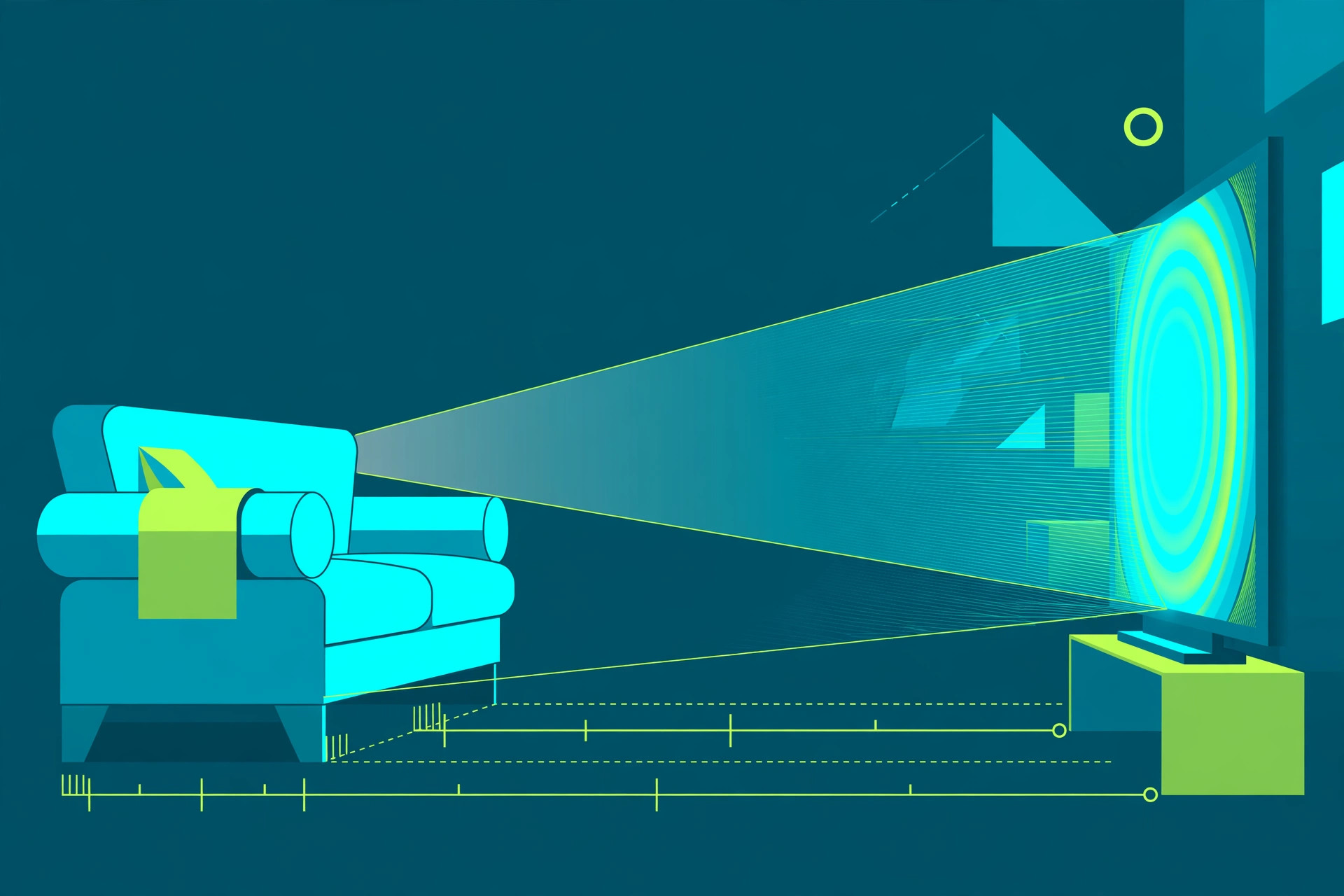
How big a screen feels depends on the angle it fills in your vision. Sit 2 metres from a 55 inch television and it spans about 31 degrees of your view. Halve the distance and it spans over 55 degrees, overwhelming. Cinema designers target roughly 40 degrees for the middle seats, which feels immersive without forcing eye movement. Living room guidance from television standards bodies clusters around 30 degrees for mixed viewing. So the right distance scales with the screen: for a 16:9 display, the 40 degree seat is about 1.2 times the diagonal away, and the 30 degree seat about 1.6 times. The viewing distance calculator converts any diagonal into both seats, in feet and metres.
Resolution sets the closest sensible seat
There is also a floor set by your eyes. Pixels are visible when each one spans more than about a sixtieth of a degree. Sit closer than that distance and the picture breaks into a grid, however good the screen. A 1080p television shows its pixels inside roughly 2 metres at 55 inches, while the same size in 4K stays smooth down to about 1 metre. This is the entire practical case for higher resolutions: they permit closer seating or bigger screens, not sharper pictures from across the room. From a typical sofa at 3 metres, a 55 inch 4K and 1080p screen are nearly indistinguishable on resolution alone, whatever the showroom claimed.
Finding your own sweet spot
Start with your actual seating distance, since furniture rarely moves for a television. Divide it by 1.2 to 1.6 to get the diagonal range that will feel right, then choose the resolution whose pixel distance is shorter than your seat. Gamers sit closer and benefit from bigger angles, up to about 50 degrees on a desk monitor, while film lovers should weight the 40 degree seat. Text work is the exception: for office screens, comfort and posture matter more than immersion, and a smaller angle with the top of the screen near eye level wins. Use the calculator with your room's real measurements, and measure to where your head actually rests, not the front edge of the sofa. Room reality gets the final vote: doors, windows and radiators place sofas where they place them, and most people choose the largest screen whose pixel distance is still shorter than their fixed seat. That is a perfectly rational order of operations, and the calculator supports it backwards as well as forwards: enter the size you are considering and read off whether your room sits inside its comfortable range. If the seat is a little far, the honest loss is immersion, not picture quality, and many viewers prefer it that way.