Password Entropy Explained: Strength Measured in Bits
Entropy counts doublings
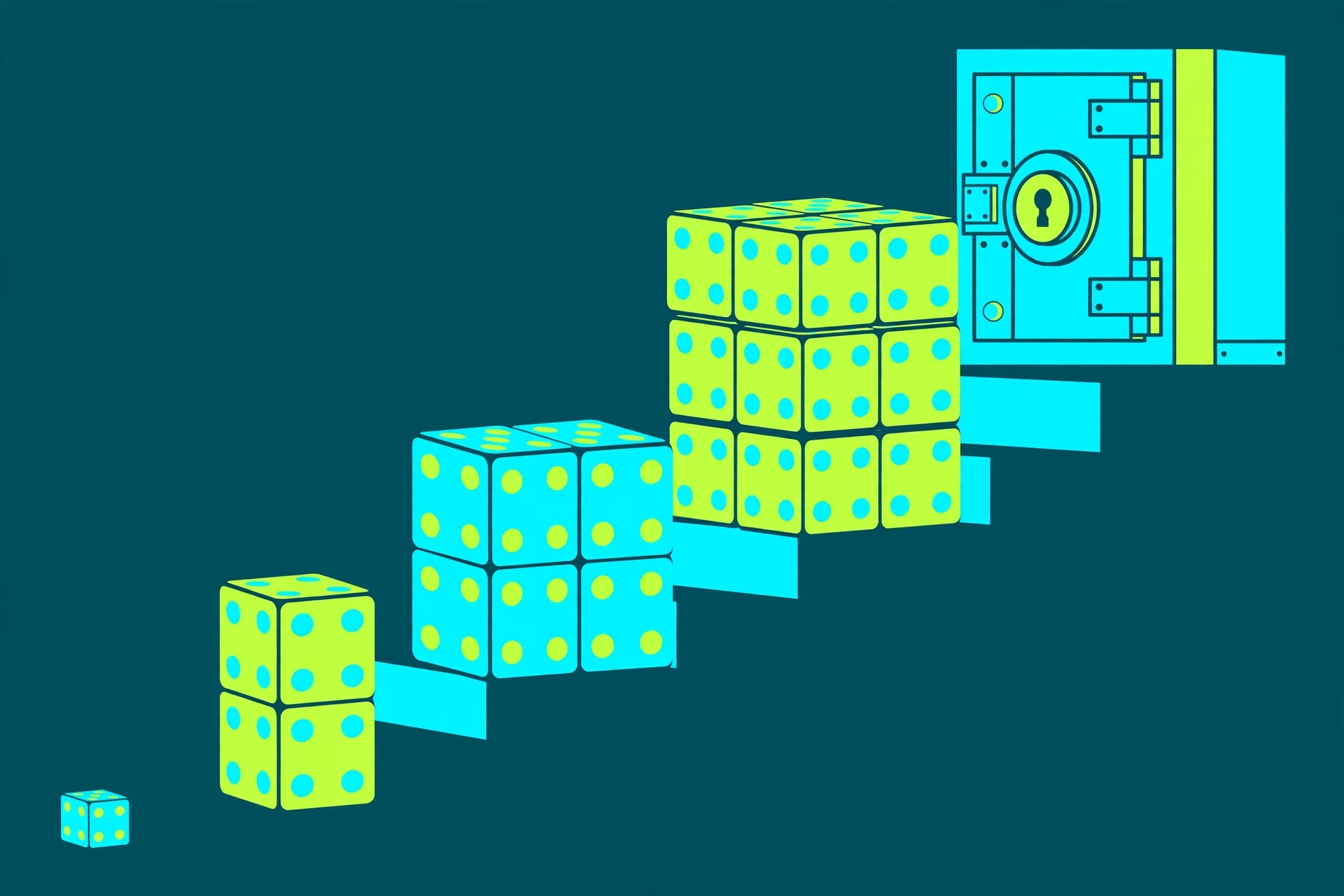
Entropy in bits measures how many times the attacker's work doubles. A password with 20 bits of entropy has about a million possibilities, since 2 to the power 20 is about a million. Each additional bit doubles the pile: 21 bits is two million, 30 bits is about a billion, 40 bits about a trillion. The formula for a randomly chosen password is simple: entropy equals the length multiplied by the logarithm of the character pool size. Ten characters from the 94 printable symbols give about 65 bits. Eight characters from lowercase only give about 38 bits. This is why strength meters speak in bits: it is the one scale where password maths becomes simple multiplication.
Why the random assumption matters
The formula assumes every character was chosen independently and uniformly at random, like dice rolls. Human choices break the assumption badly. A password like a pet's name plus a birth year might be 14 characters long, but it is built from pieces that appear in dictionaries and breach lists, so its real entropy is a fraction of the formula's answer. Attackers do not guess letter by letter in alphabetical order; they try the most likely passwords first, harvested from billions of leaked examples, then dictionary words with substitutions and dates, and only then brute force. This is why the estimator on this site warns that its figure is exact for generated passwords and optimistic for invented ones.
Reading a bits figure sensibly
As a rough map: under 40 bits falls quickly to offline attack, 40 to 60 bits resists casual attempts but not a determined offline crack, 60 to 80 bits is strong for most purposes, and beyond 80 bits guessing stops being the weak point of the system entirely. Context matters too. An online login throttled to a few tries per hour can survive on far less entropy than a password protecting an encrypted file an attacker can attack at home at full speed. Use the estimator to compare candidates and to feel the power of one more character, then let a password manager do the generating, since software dice are honest in a way human brains are not. Entropy also explains why security advice sounds contradictory. A four digit PIN has about 13 bits, laughable by password standards, yet bank cards survive because the online attack against them allows three guesses, ever. Context converts bits into safety. The same PIN protecting an encrypted phone backup file, attackable offline, would be no protection at all. So read every bits figure with its setting: the estimator here shows online and offline times side by side precisely so the setting is never hidden.