Why Your 1 TB Hard Drive Shows Only About 931 GB
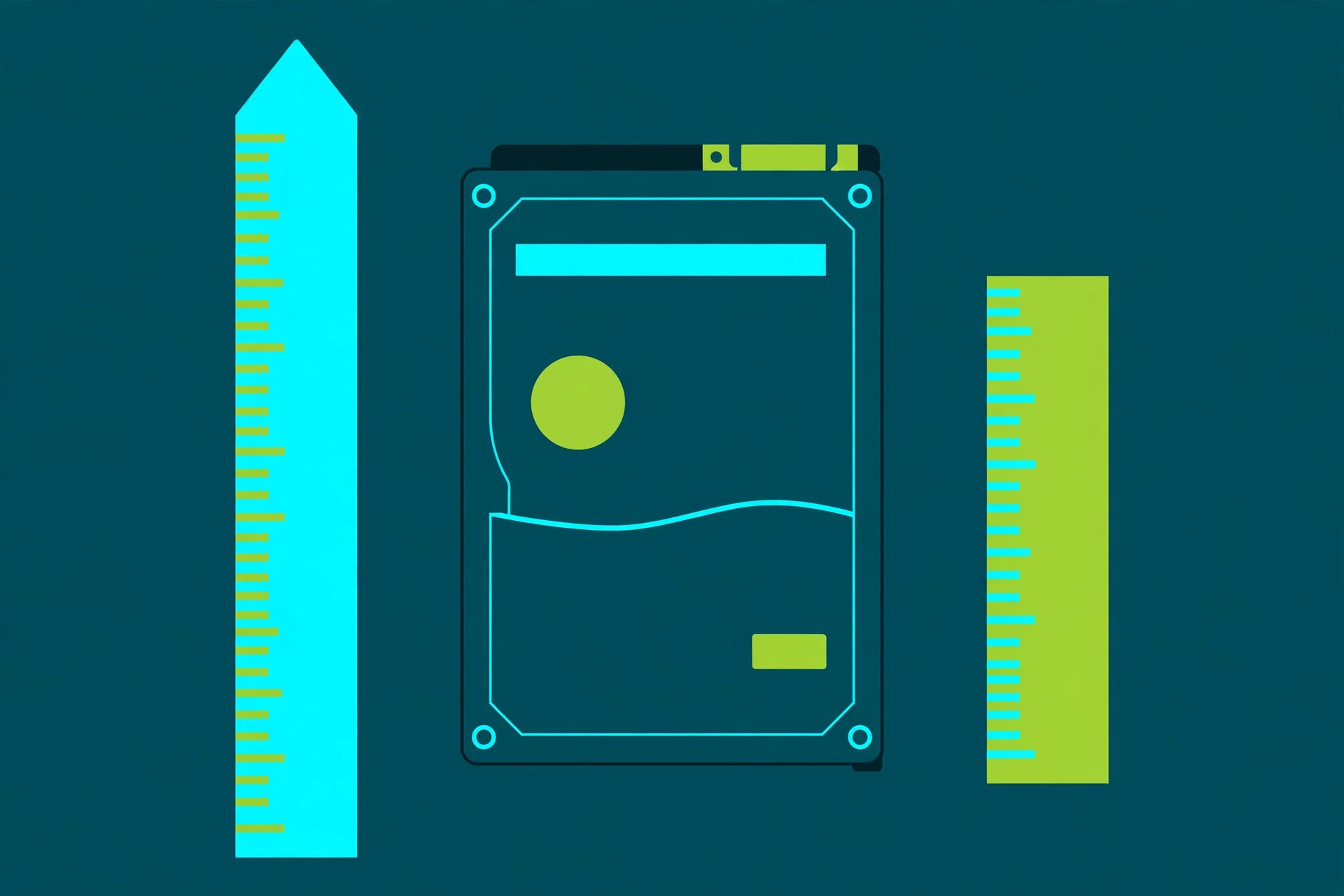
Two honest definitions of a gigabyte
There are two legitimate ways to count storage. Drive makers use decimal: a gigabyte is exactly one billion bytes, following the same pattern as kilo and mega everywhere else in science. Much software uses binary: a gibibyte, written GiB, is 1024 times 1024 times 1024 bytes, which is 1,073,741,824 bytes. Both sides are counting real bytes; they just slice them into different sized chunks. A terabyte drive holds one trillion bytes either way. Divided by the decimal gigabyte it gives a tidy 1000 GB. Divided by the binary gibibyte it gives about 931 GiB. Many systems print that second figure but label it GB, which is where the confusion is born.
Why the gap grows with size
The difference between the systems is about 2.4 percent at the kilobyte step, and it compounds at every step: roughly 4.9 percent at megabytes, 7.4 percent at gigabytes and 10 percent at terabytes. That is why an old 100 GB drive seemed to lose only a few gigabytes while a modern 4 TB drive appears to lose nearly 400. Nothing is missing, and no hidden system partition explains most of it, although recovery partitions and file system bookkeeping do take a small share. The practical lesson is to plan in bytes or in the binary units your system reports. If a backup tool says it needs 950 GiB, a drive sold as 1 TB will not hold it.
How to plan storage without surprises
Work backwards from the unit your software reports. Most backup and copying tools think in binary units even when they print GB. Convert the amount you need into GiB, then choose a drive whose decimal capacity, converted the same way, is comfortably larger. Leave at least 10 to 15 percent spare beyond the conversion gap, because drives slow down and file systems complain when they are completely full, and because your data will grow before the drive dies. The converter on this page shows decimal and binary units side by side for exactly this job, so you can check a purchase in seconds before spending anything. If you ever need to prove the point to a sceptical friend, the arithmetic is checkable on the back of an envelope: one trillion divided by 1024 three times gives 931 and a fraction. Drive makers are not short changing anyone, and operating systems are not stealing space. They are two honest rulers measuring the same desk in inches and centimetres, and the surprise is only that the industry never agreed on which ruler to print on the box.